There is one sentence I hear regularly when talking to divers about the GUE Navigation Primer:
“I just want to get better at finding my way back.”
It sounds modest, but it already contains half the answer to what navigation really is—and most divers get that answer wrong.
Navigation is not about swimming around with a rough plan and accidentally stumbling across something interesting. That’s sightseeing with a compass.
Navigation means planning a dive precisely, executing it in a way that can be repeated, and knowing exactly where you have been once the dive is over. Well enough that you can identify real waypoints, place them on a map, and find them again on future dives.
Reproducibility Is the Difference
A lucky discovery is not a navigation success.
A navigation success is being able to follow the same route a second time without improvising.
That is the standard I base this course on, and it is intentionally higher than what many divers associate with a navigation class. It also changes your role within the team. The diver who can plan a dive and execute it reproducibly is no longer simply following others—they are taking ownership.
A lucky discovery is not a navigation success. Navigation only proves itself the second time.
What’s Around the Next Corner?
Reproducibility sounds like control—and it is. But control is not the goal.
The real reward is curiosity.
Only when I know I can reliably find my way back do I have the confidence to venture farther. What’s on the far side of the island? What lies farther out in the lake? Is there a drop-off, a depression, a hole in the bottom that isn’t shown on any chart?
That’s the moment most of us are really diving for.
To me, that is the essence of navigation: not avoiding getting lost, but gaining the freedom to search with purpose.
A diver who can plan a route and reproduce it isn’t restricted by the plan—they’re enabled by it. You can investigate a feature, survey it, map it, and return on the next dive to continue exactly where you left off.
What was once “I think there was something over there” becomes a waypoint with coordinates.
That is where exploration begins: not in some remote cave system, but in a local quarry lake, with a plan and the discipline to execute it.
What Traditional Navigation Training Often Gets Wrong
Many navigation courses begin the same way: a compass lesson on land followed by swimming triangles and squares underwater.
A triangle for the sake of swimming a triangle isn’t navigation.
It’s simply a compass exercise. You swim a geometric pattern and finish where you started. That alone proves very little.
Geometric patterns absolutely have their place—but only when they are integrated into a real dive plan with a specific objective. A square pattern, for example, becomes a search technique that allows you to reliably locate a target and return from it.
The shape isn’t the important part.
The intention behind it is.
And no, I don’t teach kick-cycle counting.
In real-world diving it simply isn’t practical. In limited visibility nobody reliably counts fin kicks anyway.
What works is measuring time over a known distance.
That may sound like a minor detail, but it is the difference between a number that remains useful underwater and one that only looks good on paper.
There are a few things you also won’t find in my course:
- Basic finning lessons
- Buoyancy remediation
- Introductory diving skills
Participants are expected to arrive as competent divers. This is a navigation course, not a beginner class.
One exercise I particularly enjoy is for divers who struggle to trust their compass.
The diver takes a bearing, closes their eyes, and performs two or three strong frog kicks.
Then they open their eyes again.
The compass still points exactly where it did before.
Most people expect to emerge completely off-course; instead there’s usually a brief, almost disappointed silence because the expected drama never happens.
The truth is surprisingly uneventful:
A stable diver maintains direction remarkably well without staring constantly at the compass.
Trim and buoyancy support navigation automatically.
And a diver who previously had no reference now has one.
The GUE Navigation Primer
Course Framework
- Official GUE course with GUE certification.
- Minimum age: 14.
- Prerequisites: GUE Open Water Diver, GUE Performance Diver, or GUE Fundamentals, plus at least 15 non-training dives.
- Additional experience requirements apply for doubles and drysuit divers.
- Typically conducted over two days.
- Minimum of three dives, including one dive in reduced ambient light.
- Minimum of 16 hours of instruction.
- Maximum depth: 18 metres.
- No overhead environments.
- All dives remain within no-decompression limits.
Topics Covered
- Basic and advanced compass navigation
- Natural navigation
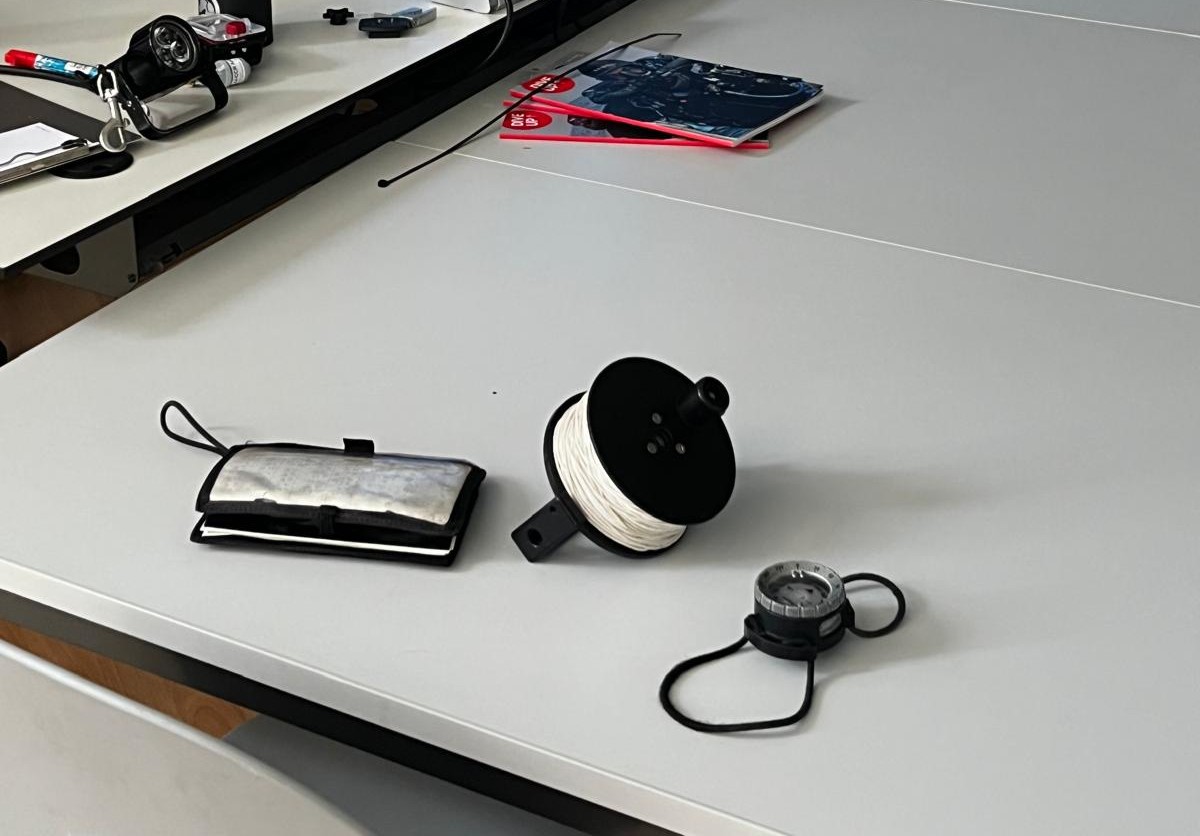
- Spool and guideline techniques
- Search patterns
- SMB deployment from a spool
Sidemount Divers
GUE does not certify students in sidemount configuration within this course.
For sidemount divers, I offer the Navigation Primer as a workshop without certification—same content, same standards, and the same expectations.
Excerpt based on GUE Standards v10.4. The current standards always take precedence: GUE Standards and Procedures
Course Structure: Two Days, Three Dives
Day 1 – Theory and Setup
The morning is dedicated to the official GUE classroom presentation.
We then move into land drills with reels, spools, and guideline deployment.
The first dive includes S- and valve drills, initial navigation exercises, landmark identification for the return route, and guideline work within the team.
Day 2 – Surveying and Mapping
The objective is to locate the beginning of a submerged feature using a specified bearing.
Once found, the team surveys the structure by recording depths, bearings, and distances between reference points.
The collected data is then used to create an actual map.
Reduced Ambient Light
One of the three dives takes place in reduced ambient light.
In our local lakes this is rarely an artificial training scenario. Descend deep enough and the environment provides the conditions naturally.
Planning Instead of Guessing: Speed and Gas
Rather than counting fin kicks, I measure time over a known distance.
Each diver swims a fixed course using their normal propulsion technique. From that, we establish a realistic and reliable swimming speed.
That speed becomes the foundation for planning routes, estimating travel times, and repeating dives with confidence.
At the same time, gas planning follows standard GUE methodology.
Measured AMV is not collected as an academic exercise—it is used directly for minimum gas calculations, turn pressures, and reserve planning.
Divers who understand their consumption can plan routes that can actually be completed with the gas they carry, rather than relying on theoretical numbers from a table.
From Passenger to Dive Leader
Ultimately, navigation is about something bigger than technique.
It is about taking ownership of your own dive instead of merely following someone else’s.
The diver who plans leads.
Not because they have the most experience, or the loudest voice, but because they understand where the team is going and how to get back.
That is the moment when “coming along for the ride” becomes “making informed decisions for yourself.”
One participant described that transition in her own words:
Participant Perspective: Diving with a Plan and Confidence
When I signed up for the GUE Navigation Primer with Christof Müller, I had one very clear goal: I wanted to feel more confident underwater.
So many times I had been diving with my mostly male dive buddies and simply followed along—without a plan and without taking responsibility. And honestly, I was tired of not being able to lead a dive myself.
I didn’t just want to know where I was underwater. I wanted to understand how to plan a dive, how to execute that plan above and below the surface, and how to return safely to exactly where I intended to.
For me, good diving is built on confidence—confidence in preparation and confidence in personal ability.
That is exactly where the course started.
We met at Deepstop in Schwetzingen for the classroom session, and I immediately felt fortunate to be part of such a great team. Alongside Christof, Christian Schweiger participated as an intern. And I honestly couldn’t have wished for a better course buddy than Arnd Polleis. Diving with him was an absolute pleasure.
Arnd—you’ve mastered communication and teamwork. 🤘
After a short introduction, we moved straight into the fundamentals of successful underwater navigation.
The theory session was well structured, highly competent, and clearly shaped by extensive real-world experience. It connected planning, orientation, communication, and practical execution into a coherent system.
One thing I found particularly valuable was learning to work with a reel before entering the water.
We practiced line deployment and attachment techniques on land first.
That was especially meaningful because, within the GUE curriculum, the Navigation Primer is the only course that introduces reel work before a later Cave course. It provides an early foundation for skills that become essential in overhead environments.
Later that day, we headed to a local quarry lake.
After a detailed site briefing, dive briefing, and gas planning session, we entered the water.
Christof first wanted to assess our core safety skills, so we completed S-drills and V-drills—a useful reminder of how important regular practice really is. 😉
The first navigation exercises took place in shallow water.
We learned how to identify and remember landmarks for the return route, ensuring we would surface in the intended location. We also worked with reels and practiced laying line as a team.
Throughout the course, I realized that navigation is about far more than looking at a compass.
It means developing awareness of your surroundings and following a clearly structured plan.
The better the plan, the safer and more successful the dive becomes—and the easier communication is for the entire team.
On the second day, we met directly at the quarry lake to discuss the two planned dives.
Our goal was to locate the beginning of a wall using a specified compass bearing.
Once found, we surveyed the feature by documenting depths, bearings, and distances between reference points.
These measurements were later used to create a map.
Suddenly, countless individual data points became a coherent picture of the wall—a true representation of the work we had completed underwater.
That moment demonstrated how much planning and structure lies behind effective underwater navigation.
And honestly, it was incredibly rewarding to create a map of something we had discovered ourselves.
The biggest lesson I took away from the course was simple:
Safety comes from preparation.
Today, I feel significantly more confident underwater because I am capable of planning my own dives and because I pay much more attention to my surroundings.
I have become a better diver—and a more self-aware one.
Thank you to Christof and Christian for their combined instructional expertise and for a fantastic course.
And thank you to Arnd for an outstanding example of what real teamwork looks like.
— Participant, GUE Navigation Primer at Deepstop Schwetzingen
Navigation in Sidemount
I am a sidemount instructor, and many of the divers who train with me dive sidemount exclusively.
Because GUE does not certify sidemount students in this course, I offer the Navigation Primer to sidemount divers as a workshop.
The content remains unchanged.
This is not a compromise.
Navigation is fundamentally about planning, awareness, and execution—not cylinder placement.
Taking bearings, conducting search patterns, managing a spool, and interpreting the environment all work exactly the same in sidemount as they do in doubles.
The standards remain the same.
The only thing that changes is the equipment configuration.
For divers considering a path toward technical diving—particularly wreck or cave diving—this course provides valuable first exposure to guideline procedures and structured problem solving.
Combined with an Intro to Tech course, it forms an excellent foundation.
Why This Is the Real Point
A navigation course that focuses only on compass work prepares divers for an emergency that rarely exists: calm water, unlimited time, and a perfectly clear head.
What really matters is understanding how your performance changes when conditions are less than ideal—and still being able to follow the route you planned.
Safety does not begin underwater.
It begins during preparation.
That may not sound particularly adventurous.
And it isn’t—until the moment you discover something beyond the next corner that wasn’t on any map before.
Reproducible navigation instead of random discoveries.
If you would like to learn the GUE Navigation Primer at Deepstop Schwetzingen and develop a systematic approach to underwater navigation, contact christof@gue.com.