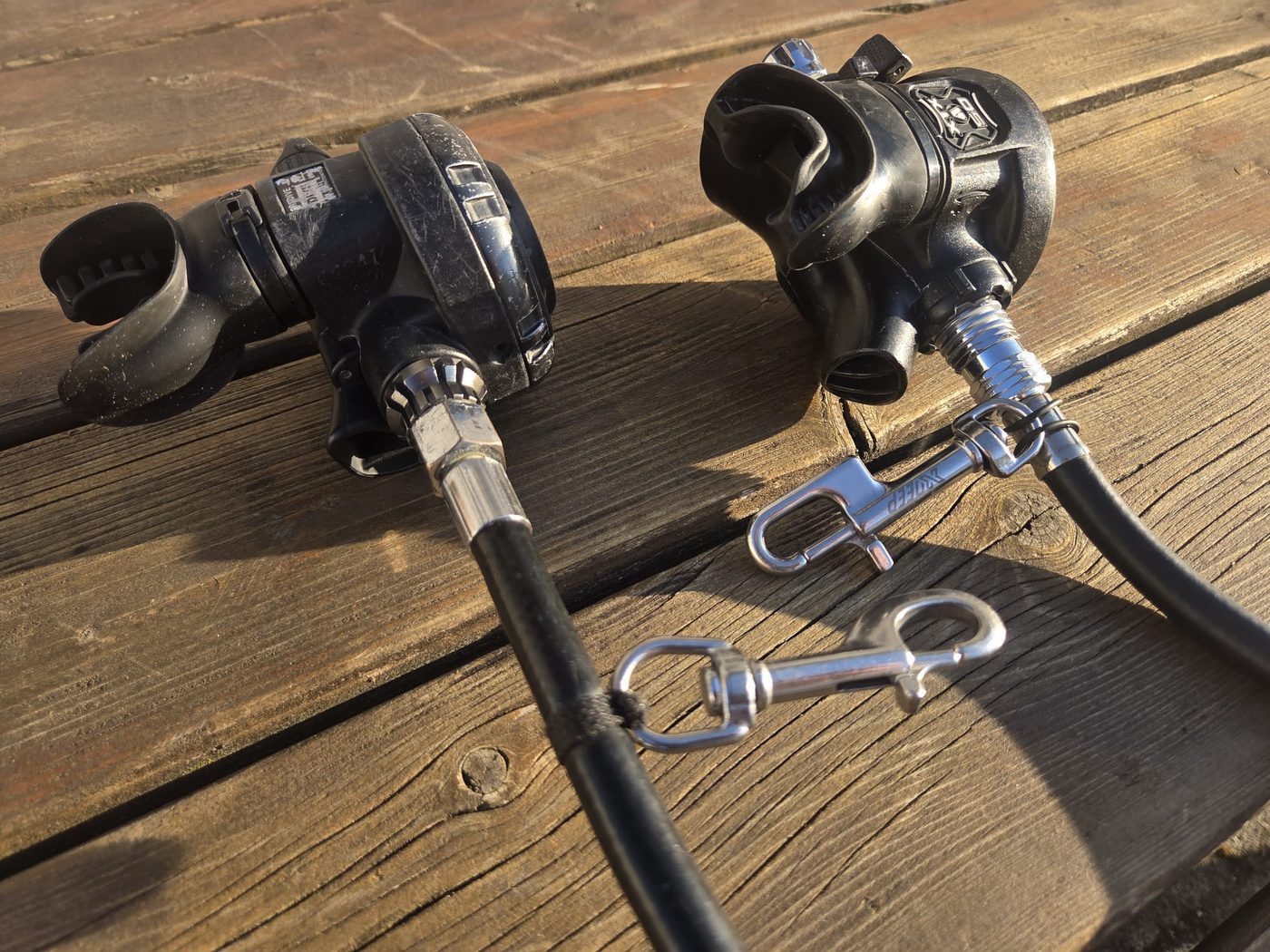
When I started diving sidemount, a breakaway on the long hose was just part of the rig. In the classes I took back then, it was mandatory. That’s how I learned it, and later it’s how I taught it in my own sidemount and Advanced Nitrox courses.
Then I was in Tulum with a few of my students while they did their Full Cave with Protec. The first thing raised about their rigs was the breakaway: take it off, go fixed. Protec’s instructors don’t miss much, so I took that seriously. It was one instructor’s comment on one specific setup, not a written rule I could quote here.
I’ll admit that threw me at first. The breakaway had been my standard for years, and maybe it isn’t anymore. I’ve thought about it a lot since. The short version: it depends less on the hardware than on two things, how solid your grip is under stress and where and who you dive with.
Why the breakaway exists
In sidemount we switch between cylinders to keep them balanced. That means half the time the long hose isn’t in your mouth. It’s clipped off to a chest D-ring with a bolt snap. In backmount this hardly comes up, since you breathe the long hose anyway and donate it straight from your mouth.
The scenario I train for looks like this: 4°C (39°F) water, half an hour into deco, hanging almost motionless and slowly getting cold. Thick drygloves over liners, numb fingertips, fingernails that already hurt. Add stress, because if you need that grip at all, something has already gone wrong.
With a classic long hose / short hose setup there’s one more thing: there is no second donation route. The short hose reg sits on a necklace right under your chin and is simply too short to hand over. If you donate, it’s the long hose.
That’s where the breakaway comes in. Give the hose a hard yank, the weak link lets go, the reg is free. No fumbling with a bolt snap on numb fingers.
I still tell my students: a gas donation has to work with cold, numb fingers and thick gloves. If you can’t get the bolt snap off the D-ring like that, a breakaway is the obvious fix.
The catch
Unclipping can be trained, under stress too. With enough reps a bolt snap opens smoothly even with numb fingers. That’s certainly how it went for me.
The bigger issue for me is something else. A breakaway is built to give under load, and the o-ring doesn’t care whether I’m pulling because I want to donate or because the hose just snagged on the line. And there’s load on that hose all dive long: in a restriction, while clipping stages, when a buddy grabs it, or just from the flow on a scooter.
An example from my own diving: running the Sidewinder behind a scooter over long distances puts constant water pressure on hoses and kit. An older, brittle o-ring or a home-printed clip can let go there without me noticing.
The second problem is age. Rubber goes brittle, thin line chafes through, and with a printed clip the release load depends heavily on how it was printed and from what. The whole concept relies on a known release load. With an aged o-ring, that number is a guess.
Sure, you can maintain a breakaway. Swap o-rings on a schedule, spares in the save-a-dive kit, done. At the level where people think about this stuff, that’s no big deal. But it only takes care of the ageing. A brand-new o-ring still lets go when the hose catches on the line.
“Murphy is a cave diver. And he picks the worst possible moment.”
So there are two ways to fail. A fixed bolt snap makes my life harder exactly when I need to donate: unclipping takes longer. But the reg stays put, and the problem is in my hands. For the rest of the dive, nothing happens.
The breakaway is the other way round. It wins at donation time, but its problem shows up on an ordinary dive. It can release without anyone noticing. Then the long hose dangles below me, drags through silt or tangles in the line. And when it’s needed, it isn’t where your hand goes looking for it.
So the breakaway pays off in the one rare moment when someone needs gas. The risk comes along on every dive.
On top of that, the bolt snap is only one step. The hose still has to come out of its routing, be deployed cleanly and handed over. If that isn’t dialed in, a breakaway won’t help much.
It depends where you dive
All of this assumes a well-drilled team. In sidemount we have double redundancy, two fully independent gas supplies. For my buddy to need my long hose, he needs a double failure.
In a team like that, an out-of-gas rarely comes out of nowhere. More likely your buddy signals that he’s losing gas, you share, and you calm things down before it gets tight. There’s slack in that, and the few seconds a breakaway saves hardly matter. Whether it plays out that way depends a lot on where and who you dive with.
Cave
This is where I see the strongest case against the breakaway. A loose long hose snags on the line or in the next restriction, and there’s no way up. At the same time, most people diving cave have drilled the unclip so often that it’s solid.
Technical open water with deco
This sits in between. Deco means there’s no straight shot to the surface here either, but there’s no ceiling for a loose hose to hang up on, at most a buoy line. And usually you’re diving with people you know, on a plan you made together.
Recreational diving
Recreational diving is a different story again. Random groups, people you met at the briefing, a wide range of skills and the occasional nasty surprise. The warning time I assumed above often isn’t there.
And if the diver in front of me is already having a rough day, every second I spend fumbling with a bolt snap makes it worse for him. A lot of that simply isn’t in your hands. If your grip isn’t solid under stress yet, a breakaway makes good sense here.
My recommendation
In the end it comes down to something only you can answer: whether you can get that bolt snap open reliably in the cold, in thick gloves and under stress.
If not, a breakaway can make sense in open water. A loose long hose is a manageable problem there, and without a deco obligation the way up is still open.
If your grip is solid, you don’t need the weak link, and a fixed bolt snap is the lesser evil. The closer you get to cave or mine diving, the less you can afford a hose hanging loose somewhere without you knowing.
Going fixed
- Tie it on with cave line and check the knot every time you rig.
- Practice unclipping and donating regularly, ideally at the end of the dive when your hands are cold. At the start with warm fingers, it always works.
- The grip has to work blind, in trim and in the gloves you wear in winter. In a long hose / short hose setup there is no second donation route.
Running a breakaway
Treat it like any other safety-critical part. Same material every time, fixed replacement intervals, a quick check before every dive and spares in the save-a-dive kit. With an o-ring that’s been on there for three seasons, nobody knows anymore what it takes to pop it.
Tulum didn’t convert me, but it did make me run the numbers on an old habit. If you see it differently, drop me a line. I’m open to being convinced.
Long hose handling, gas donation and cylinder switches with stage and deco bottles, trained in gloves in open water: learn it systematically in the TDI Sidemount Diver course.