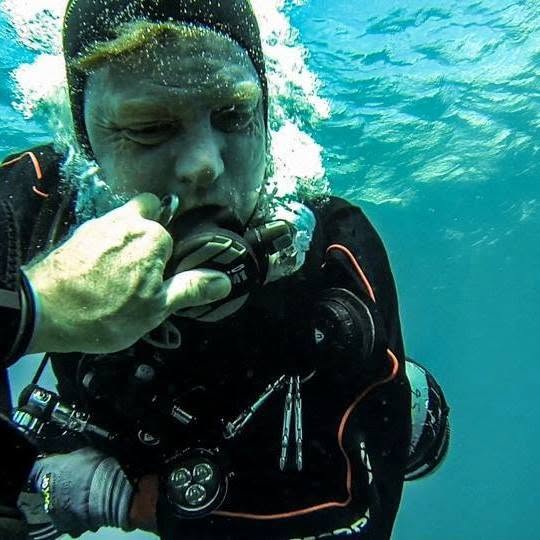
Every step in my diving started with the same sentence: something’s missing. No master plan, no bucket list, no collecting cards. Just that question, which popped up every time I felt I’d stopped making progress — and was never answered by money or a new certification. Instead, the answer was always the same: train harder, with people who are genuinely better. It pushed me from Open Water all the way to cave CCR. And it nearly always ended in sidemount.
November water, and a backplate from day one
It started with a voucher for an Open Water course at a local PADI dive school. I began in November — about as uncomfortable as it gets for learning to dive in Germany. Theory and pool sessions ran right through the winter, and I didn’t finish open water until spring.
Looking back, the timing shaped me. I didn’t learn to dive on a warm summer holiday but in cold water, over months, in small steps. Diving was work for me from the start, not recreation — and that never changed. I was hooked immediately: Advanced, Rescue and Drysuit certifications followed suit.
I never owned a jacket. I went straight to a backplate-and-wing, without being able to really explain why at the time. It simply felt like the right choice: a clean system instead of a bundle of straps and pockets. Only years later, in the GUE world, did I get the language for what had until then been pure instinct. But the reflex was already there — and it became the thread running through everything.
The first time in the sea
Until then I only knew the murky local lakes. I’d learned to estimate depth from cold and visibility, not from a computer. I did have a dive computer, but you had to press a button for five seconds of backlight, and then you got black text on a grey background — not exactly easy to read in the thick cloud of brown water. So it came down to a rule of thumb: when the water hit a certain temperature and the visibility dropped off, I roughly knew where I was. A lake forces you to be precise with very little information.
The first time I got to dive in the open sea, I was floored. Suddenly water was a space, not a black wall. I could see where I wanted to go instead of feeling my way there. Ironically it was the hard school of the lake that showed me how much room the sea actually offers — and how little of it most people use. That fascination never wore off.
The back-kick everyone laughed at
Around that time I taught myself the back-kick. Nobody could understand why I’d want it; there was more than one smirk at the poolside during the Sunday pool session. Back then a back-kick was something for “people with the strange fins,” not for a recreational diver.
To me it wasn’t a trick. It was the first clear realisation that control in the water is a skill you train — not something you buy with gear. Anyone who can back out of a position without stirring up silt has understood that position and propulsion are separate problems. That distinction later became extremely important in technical diving. In parallel, I spent more than a year working toward divemaster.
The answer to “something’s missing” was never a new tank or a new card. It was always the same: train harder, with people who were genuinely better.
What’s around the next corner
At some point it wasn’t diving itself that drew me, but what lay beyond my sight: what’s actually sitting in the middle of the lake? What’s around the next corner? What does it look like over by the island. I wanted more gas so I could go and look — not to go deep, but to go further.
The first time I had a set of double-12s on, I just walked around the car park with it — I didn’t even taken it into the water. Shortly after, I saw the iconic sidemount video by Steve Bogaerts, and a lot suddenly fell into place: sidemount was the path that fit my curiosity — slim enough to get where things get tight, and wonderfully elegant once it’s rigged correctly.
Sidemount — first alone, then properly
I came to sidemount with no help: no guides, no instructors, and no proper gear. Just the feeling that I’d plateaued. I slung tanks on and experimented — and quickly learned that “experimenting” in sidemount is a good way to burn in bad habits and to despair completely in the process.
That settled it: I wanted to train with Steve Martin on his Sidemount Essentials — what you’d call Fundamentals today. Personal circumstances made that impossible, so I ended up with Peter Tschannen, Sidemount World on Gozo and the Innerspace Explorers agency. The Basic of Exploration (BOE) and the Sidemount Workshop were hard and demanding — and exactly what I needed. For the first time I had structure instead of trial and error: someone who didn’t just tell me that something was wrong, but why, and in what order to fix it. That was the moment “diving a lot” first turned into “getting better”.
Trimix, DPV — and a gap in the market
With Audrey Cudel and Tom Steiner came the ISE Exploration Diver 1, i.e. trimix. That shifts the scale: it’s no longer just about clean position but about planning, gases, and the fact that every bit of sloppiness now costs more. I did the ISE DPV later, also on Gozo — scooters force you to hold trim and attention at higher speed, which makes every weakness in your fundamentals brutally visible.
Somewhere in there I started working in sales at Deepstop.de, advising mainly on sidemount. One thing became clear back then that is still true today: finding someone who really knows how to advise on sidemount — configuration, weight distribution, tank choice, body type — is rare. There’s a lot of selling and very little advice. That gap sharpened my direction — and filling it is still my job today: if you want a sidemount setup that fits your body and your diving rather than what’s on the shelf, you’ve come to the right person.
GUE land and the double-12s
I’ve taught since 1996 as an IT instructor — somewhere between 50,000 and 60,000 people have come through my courses over the years. Teach that long and you learn one thing: having knowledge and making it teachable are two completely different disciplines. I still never intended to teach diving.
But Deepstop is effectively GUE land, and there’s no getting around the double-12. So I did my GUE Fundamentals with Hans Drexler. When I ended up actually diving a set ou doubles, I understood why everyone was talking about a tidy, clean, streamlined rig — and it’s true. I’d just come from sidemount, and the first time I felt like a fridge that had learned to swim: two tanks strapped on behind me that I could neither see nor touch, and my sidemount brain kept trying to find them the whole time, like reaching for the light switch in a dark hotel room. The double-12 was flawless — the only one thrown off was me. Both approaches work.
The GUE school gave me the vocabulary and the discipline for what had been gut feeling before: trim, buoyancy, team, standardisation — not as buzzwords, but as standards you can actually check against. It made my diving measurable. To be able to teach within GUE myself, I added GUE Tec 1 with Derk Remmers — followed by the Instructor Examination (IE), after which I’m qualified to teach GUE Fundamentals.
Diving and teaching sidemount still barely happened in that world — and that’s exactly my place. So I earned the SDI/TDI instructor rating, the certification I teach sidemount under. What I learned at GUE goes straight into the quality of the teaching: that combination — GUE standards, delivered in a sidemount course under SDI/TDI — is what I offer today.
Cave, Sidewinder, CCR
Even before my GUE Fundamentals I’d started cave diving with Kim Davidsson at Protec Tulum. Kim is Swedish and a co-owner of Protec; he has taught cave diving full time since 2009 and has explored the systems of the Riviera Maya for over two decades — one of the most experienced cave instructors you’ll find. With him, Full Cave was the first step; the Stage Cave and the Cave DPV came after. The cave is the most honest teacher there is: it forgives no weak foundation, because there’s no way out upward. Everything that’s merely ugly in open water becomes a problem here.
Kim became a good friend. These days I spend nearly every holiday in Tulum, diving and learning with him. He’s the one who told me to get a Sidewinder, and supported me on that path. Then came several hundred hours on the unit — the phase where a CCR turns from a foreign object into an extension of your own breathing.
Then Kim came to me and said he wanted to do the cave CCR course with me, with Jake Bulman as an instructor. It was hard because everything overlaps here: on a closed circuit there’s no longer a simple answer. Every problem I’d solve on open circuit with a single reach becomes a chain of decisions on the CCR — loop, bailout, hypercapnia — made in an environment with no fast way out, while you need to maintain your focus on navigation, gas and team position. A mentor choosing to be a student next to you again says more about the right attitude to learning than any certification. It was the course that pushed me hardest.
The end point of my diver training was the Cave Survey course, again with Kim — from diving a cave to measuring and mapping it. The point where “getting through the cave” becomes “recording the cave.”
Today
Today I keep working my way up the TDI instructor ladder. Not because a plan says so, but because sidemount fits me best — and because the same question from fifteen years ago keeps nagging me: what am I still missing? The only thing that’s changed is the answer. Back then I was the one missing a course. Today the scene in Germany lacks instructors who teach sidemount on the foundation I had to piece together over years.
My path was never a stack of cards. It was a refusal to stand still — and a willingness to seek out the people who were genuinely better, instead of telling myself I’d already arrived. That’s the foundation of every course I teach today.
Learn sidemount — on a GUE foundation
If you want to build sidemount on that kind of foundation, rather than buying gear and hoping for the best: the entry into sidemount training runs through TDI Intro to Tech, which I teach in sidemount to GUE standards. Send a course enquiry
Gear & honest sidemount advice: Deepstop.