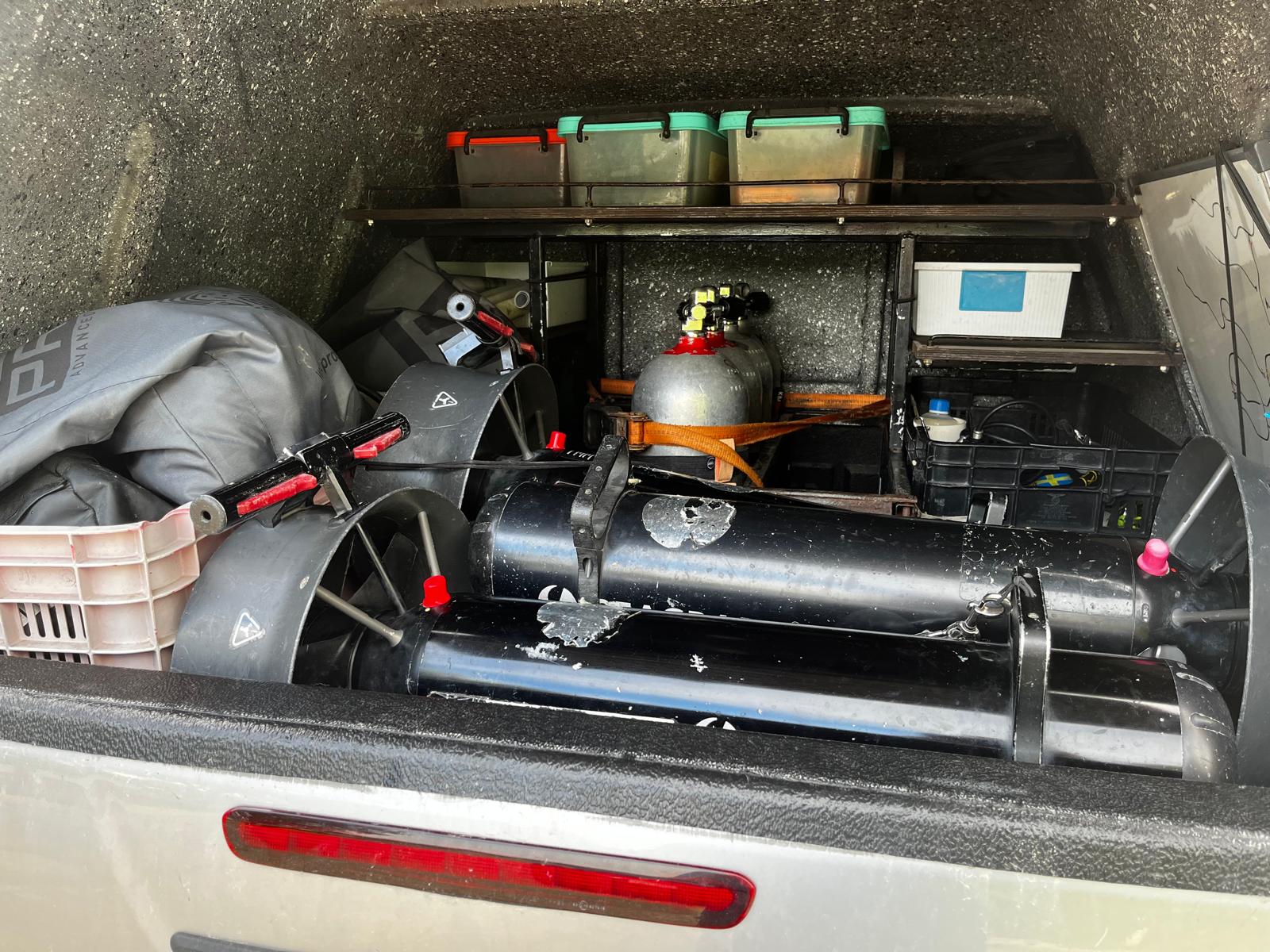
A scooter looks like a shortcut. Pull the trigger, drift past the reef, and you barely move your fins. That image is exactly what most divers have in mind when they buy a DPV — and exactly why they underestimate it. It shows the glide and hides everything else.
Learning to pull the trigger takes minutes. What makes DPV diving demanding isn’t the machine, but what it requires from you: awareness — and a whole lot more of it than in regular diving.
How Do You Actually Get Back Out?
Before talking about driving, ask an unromantic question: How do you get home? It sounds trivial, but it defines two completely different dives.
Scenario 1 — you can ascend at any time. Open water, nothing above you but water and eventually air. If something goes wrong, you go up — not elegant, but safe. Here, the scooter is comfort.
Scenario 2 — there is only one way out. A boat you must return to. A current you cannot beat without a DPV. Or a cave that offers no shortcuts. Now the scooter is no longer comfort — it’s your return ticket. And return tickets are best booked before you leave.
This isn’t a matter of taste. It determines how much gas you may burn, how far you can go, and when you must turn around. Two divers, same scooter, same water — and two completely different ranges, simply because one must return and the other doesn’t.
What It’s Really About: Awareness
The demanding part of DPV diving isn’t the finger on the trigger — it’s your head. A scooter lets you go faster, farther, and often deeper. Everything around you changes quicker than you’re used to.
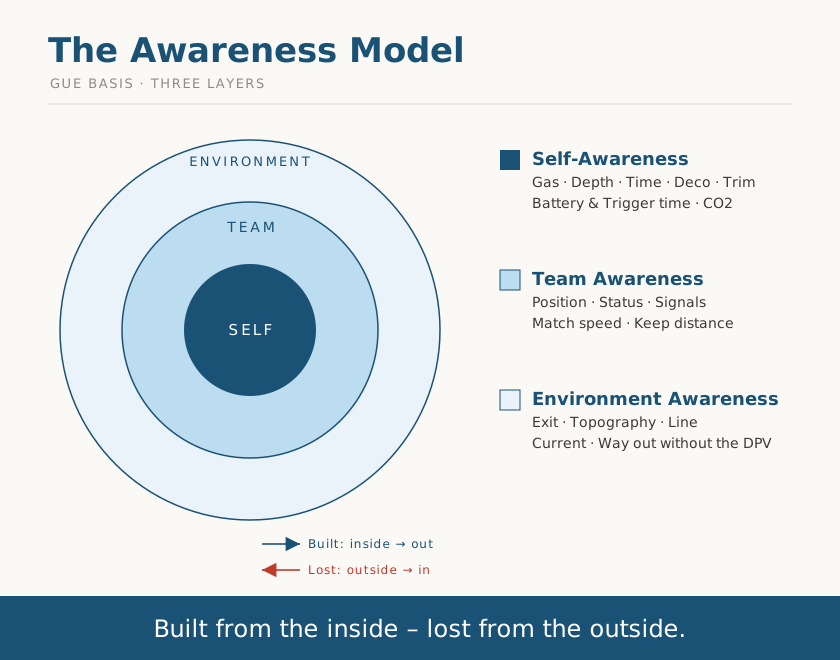
GUE sorts awareness into three layers, from the inside out.
Yourself. Gas, depth, time, deco, buoyancy, trim — plus battery, trigger time, and breathing on top for the DPV side of things.
Your team. Scooters separate teams quickly. Staying together is active work: matching speed, keeping distance, maintaining visual contact — while operating the DPV.
The environment. Exit points, topography, line, current. With a DPV, all of this rushes past at a pace that leaves little time to think.
Awareness is finite. Every skill you don’t have on autopilot eats away at it — from the outside inward. First you lose the environment, then the team, and finally everything collapses into yourself. That’s why the fundamentals must be solid before adding a scooter: so the machine doesn’t consume all your attention.
All Skills — Now With a DPV
Everything you can do normally, you must be able to do with a DPV as well. Twice, actually: standing still and at full speed.
Valve drill, S-drill, mask clearing, gas sharing — all one-handed, because the other hand remains on the scooter, and with a meter of machine pulling at you. On the platform, everyone looks clean. Under thrust and with a tilting body position, theory separates from practice.
Sidemount adds its own twist. Sidemount and DPV are a dream team: slim profile, cylinders tight to the body, and a scooter in front is a real advantage. The catch: gas switches, tank handling, regulators, and valves are all handled by you. That extra workload now happens under thrust, one-handed. Sidemount rewards those whose hand movements are set — and exposes those who still search for them.
Problems Increase As Well
Things get interesting with two divers and at least one problem.
Gas sharing while one or both are still driving: deploy the long hose, maintain contact, control the scooter one-handed — all simultaneously. Your buddy’s scooter dies? You tow them — the entire distance you just raced on the way in. And then the classic: the runaway. A scooter stuck on full power, pulling you wherever it wants.
None of this is exotic. It’s part of DPV diving — and the reason it takes more than two fun dives.
Planning That Changes More Than Speed
The most dangerous sentence in DPV diving has five words: “The battery will surely last.”
It probably will. But the fullest battery in the world is useless if your gas runs out first. Your range is defined not by the battery, but by the gas you need to get back out — in the worst case without a scooter, swimming or towing at walking speed. A DPV can take you far enough that the point of no return lies much closer than the nice speed suggests.
DPV dives are planned backwards — from the exit, not from the fun. First comes the reserve that guarantees you can get out safely; that part is sacred. Only then comes the question of how far you may go. The battery almost never answers it. Gas does — sometimes deco.
Driving — And Why It’s Fun
A DPV has no steering wheel. You control it through several things at once:
- Body position — you “lean” into turns; your stretched body acts like a fin.
- Fins — small corrections, like rudders, from the wrist.
- Scooter angle — pitch the nose up, down, or into the turn.
Small inputs, not big gestures. Gripping the handles and pulling with your arms makes the ride jerky.
The buoyancy trap
Thrust hides bad buoyancy. The scooter holds your depth even if you’re not neutral — like a wing that carries as long as it has speed. Release the trigger, and that help is gone instantly — you sink or rise before you even notice. That’s why you adjust buoyancy while riding, exactly when you feel the change the least.
A DPV must fit you: leash length, angle, attachment point. A poorly fitted scooter pushes you into bad trim and fights you the entire dive.
Add clean stowing without silting out the ground, spacing and formation, matching speed, not running into your teammate’s tail. This is the part that’s genuinely fun. Time invested here pays off — clean riding makes everything else easier. But it replaces nothing.
What Must Be Solid First
A scooter only becomes worthwhile once you reach a certain point — and that point isn’t defined by the machine, but by you.
Stable trim, solid buoyancy, drills on autopilot: these must be in place before adding a DPV. Otherwise all your attention goes into holding the basics together — and the new part is exactly where things can go wrong. If you’re calm and your hand movements are automatic, your head is free for what the scooter adds.
This isn’t meant to scare anyone. It’s simply the difference between you riding the scooter — or the scooter riding you.
When a Scooter Turns From Toy to Tool
A quick look ahead — not course content, but the answer to why all this effort is worth it. Some dives aren’t just more comfortable with a DPV — they’re pointless without one. For two reasons often confused: depth and distance.
Depth. Deep trimix, multiple stages, and the aerodynamics of a refrigerator — every meter costs effort. Effort increases CO2. A scooter removes exactly that load.
Distance. How far you can penetrate a cave, independent of depth. On the way there you use up so much gas and time that the actual target becomes unreachable without a DPV. In caves, both often come together: far in and deep down.
Important: this is cave DPV — a completely different league. GUE DPV 1, SDI DPV, and TDI Technical DPV are open-water courses — no overhead, no cave scooters. That comes much later, on a very different foundation.
A glimpse of where this leads — sidemount in the cave
What Lies Beneath
A scooter is an amplifier. It makes good trim better and bad trim worse; calm drills calmer and chaotic drills chaotic; a strong team stronger and a loose team separated. It doesn’t make you a better diver. It makes you faster — and more visibly the diver you already are.
Serious DPV diving doesn’t start with the scooter. I teach DPV — and that’s exactly why I say it clearly: the scooter is not the beginning. The beginning is the foundation beneath it: trim, buoyancy, drills under load, team. Clean enough that a machine magnifies them instead of breaking them.
If you want to build that systematically: SDI DPV Diver and GUE DPV 1.