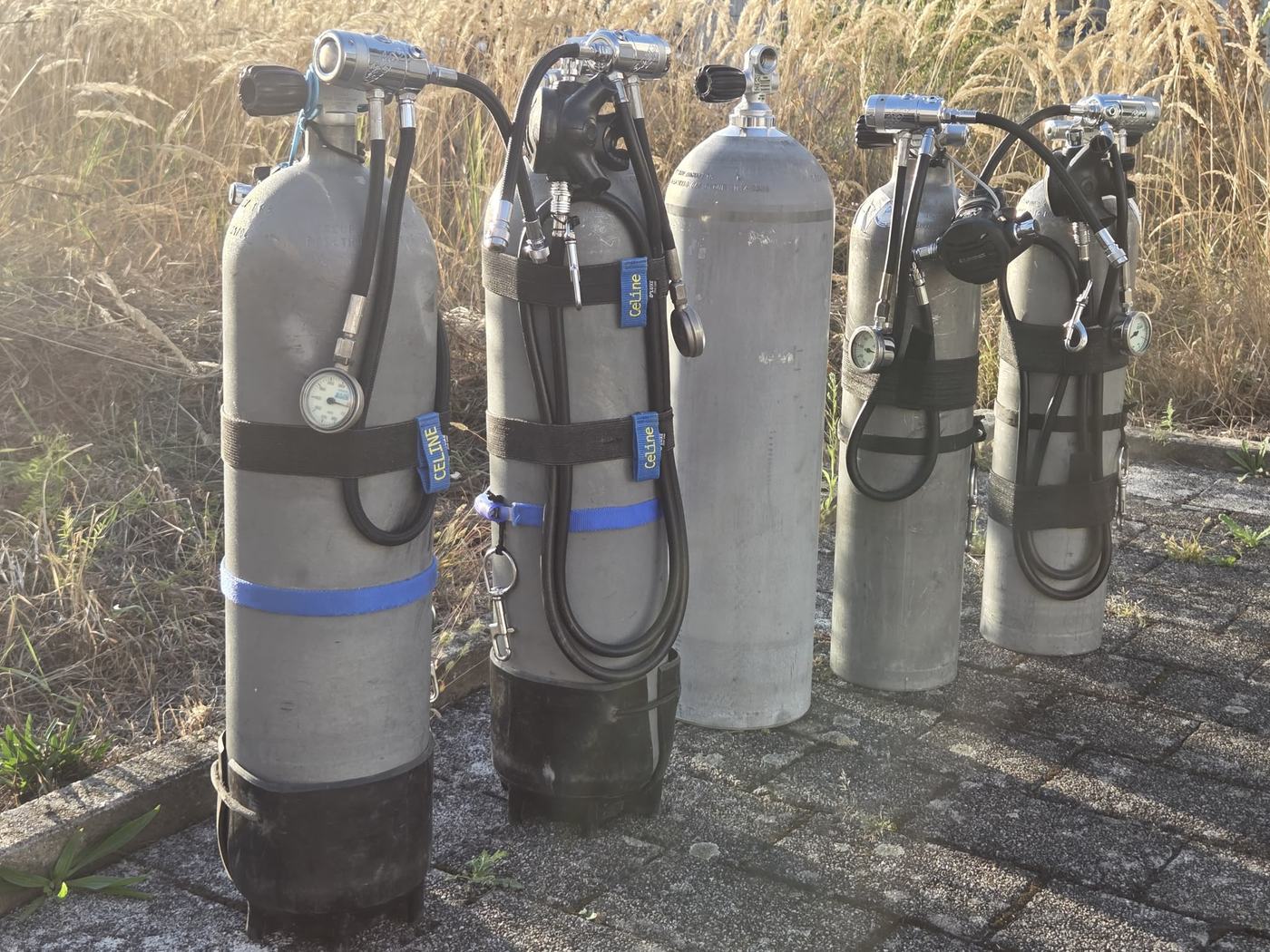
Close to fifteen years of sidemount diving has put most tank types in my hands. I started on 8.5 litre steel, moved to the AL80, went to heavy steel after that, and for many years now I have dived light steel. Every type has its place, and every type charges you for it. What I still do not follow is how many divers here reach for aluminium when neither their wallet nor their logistics force them to.
This is not a materials primer for beginners. It is my reasoning for one specific choice in a cold lake.
Why tank choice matters more in sidemount than in backmount
The tank hangs along your side, so it acts on your trim directly. Two properties drive everything else:
- How buoyancy changes from full to empty. You breathe the tank down, it gets lighter, and it gets more buoyant. The size of that swing decides how much the tank’s attitude shifts over the course of the dive.
- Whether the tank is part of your weighting. A tank negative enough to count as ballast cannot be ditched in an emergency without sending you positive on the spot. A tank that sits close to neutral at the end comes off cleanly. These two properties are where the types part company.
AL80 (aluminium, 80 cubic feet)
This is the type I find hardest to justify in Germany, unless there is a real financial or logistical reason for it: a holiday destination, rental tanks, no gear of your own.
Aluminium runs clearly positive when empty, and that buoyancy has to be answered with lead. In a cold lake that is the whole point. A drysuit with a thick undergarment already leaves you with plenty of buoyancy to offset. The aluminium tank stacks another helping on top of a pile of lead you would not need behind a steel tank.
In sidemount that lead usually sits on the harness across your back, which is exactly where it presses into your lumbar spine. If your back gives you trouble, you notice it before you ever reach the water, standing up out of a crouch with the rig on.
The balanced rig deserves attention here as well. Every kilo the aluminium tank demands adds to how negative you are when you enter the water. Two things still have to add up after that. Your wing has to carry that load with something in reserve rather than working at the limit of its lift. And the ascent has to stay possible if the wing fails. Both calculations get tighter with every extra kilo on your back.
Then there is the weight of the tank itself. An empty AL80 sits at roughly 14.5 kg (32 lb), a 12 litre light steel tank at roughly 12.2 kg (27 lb). That is a good 2 kg per tank, so about 4.5 kg more to carry in a sidemount pair before a single gram of lead joins in. The aluminium tank is both the lead-heavy option and the heavy one.
All of it ends up on the walk to the entry, carried over gravel, down steps, along a bank. If your hips or knees are the weak link, this is the part of the dive that costs you most.
Practical relevance: for divers who came to sidemount because of back, hip or knee problems, this is not a comfort question.
For long, deep dives in a cold lake, the AL80 is the choice that forces the most unnecessary lead on you, under water and on the way there.
Heavy steel tanks
The opposite end. Heavy steel stays strongly negative through the whole dive, empty included. The upside is obvious: little or no extra lead.
The bill arrives elsewhere. The tank becomes part of your weighting, because you factor its negative buoyancy in permanently. It also never feels fluid in sidemount. Diving it is closer to running on rails. The lateral mobility and the fine trimming that make sidemount worthwhile both disappear. The end result feels remarkably close to a set of back mounted doubles, only sideways. If you dive sidemount for position and trim control, you have handed part of that reason back.
The 12 litre light steel tank: my compromise for cold lakes
For me this is the sweet spot, for several reasons at once:
- Close to neutral at the end. At around 40 bar remaining, the tank is near neutral. It is not a fixed part of the weighting system and it ditches cleanly.
- No more lead than aluminium. It needs less, not more. The pile of lead on your back stays small, and nothing digs in where it should not.
- Easy to handle under water. Clipping, shifting and controlling it is straightforward, without the on-rails feel of heavy steel.
- Enough gas for dives worth doing. Twelve litres gives you the volume to dive more demanding profiles sensibly.
It brings the low lead of a steel solution without the rails, and it stays manageable without the buoyancy ballast of aluminium.
7 litre aluminium: bailout and easy shallow dives
Aluminium still has a place in my own diving, just not as the primary tank on a cold, deep dive.
- As a bailout tank on a CCR. A 7 litre aluminium cylinder is a clean solution there.
- For easy shallow dives. When I want to hang around at two or three metres in a wetsuit in warm water and look at fish, the small aluminium tank is exactly right.
The moment I dive my Sidewinder seriously, I want my 12 litre light steel tanks with me, simply because they carry more bailout. And nothing beats more bailout.
Overview
| Tank type | Empty weight | Buoyancy when empty | Lead needed | Handling in sidemount | How I use it |
|---|---|---|---|---|---|
| AL80 (alu, 80 cuft) | approx. 14.5 kg | clearly positive | a lot | fine, but lead-heavy | only when necessary (destination, rental) |
| Heavy steel | varies by model | strongly negative | little or none | on rails, part of the weighting | rarely, gives up the sidemount advantage |
| 12 l light steel | approx. 12.2 kg | close to neutral | little | very good, ditchable | primary tank, cold lake |
| 7 l alu | light | positive | none | light, compact | CCR bailout, easy shallow dives |
Conclusion
There is no single correct tank, but for a given profile there is a correct choice. For serious sidemount in a cold German lake, the 12 litre light steel tank is my best compromise: little lead, clean to ditch, easy to handle, enough gas. Aluminium pays off once a financial or logistical reason speaks for it, not as a default. Heavy steel does solve the lead problem, but it charges you exactly what you dive sidemount for.
Pick your tank by how its buoyancy changes and by whether you want it inside your weighting system, not by purchase price alone.
Tank choice, weighting and the balanced rig are covered in the SDI Sidemount Diver and the TDI Sidemount Diver course.