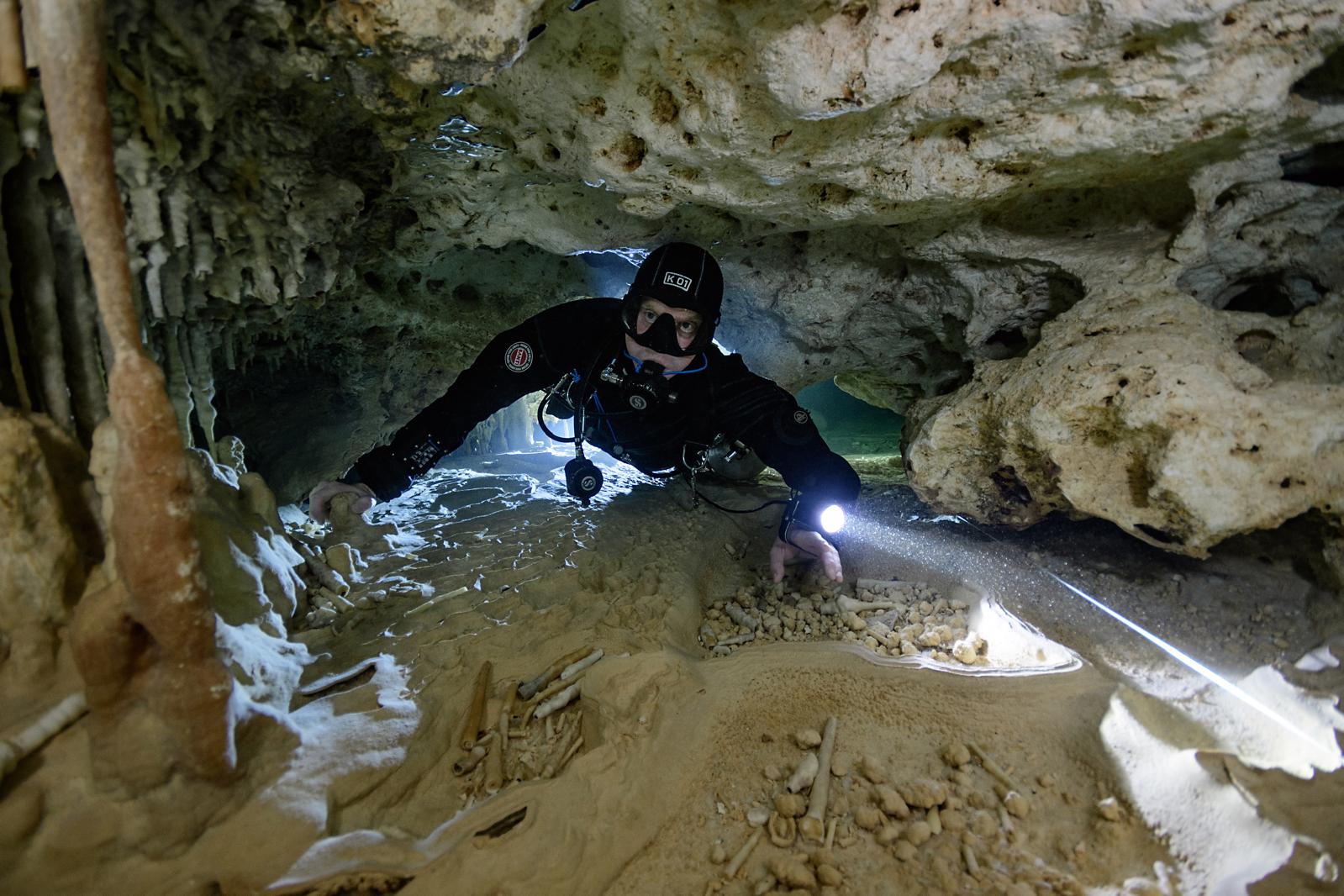
There’s a debate that repeats endlessly in forums, on boats, and after dives: “Which is better – backmount or sidemount?”
The answer is as unsatisfying as it is correct: there is no system that wins in every situation. There is only the right tool for the right job. Ignore that, and sooner or later you’ll find yourself holding the wrong hammer.
First, a clarification of terms, because they get mixed up constantly in these debates: backmount is a configuration – cylinder(s) on the back, mounted to a backplate and wing. Doubles 12 or Doubles 18 is a cylinder choice within that configuration. You can dive backmount mono, or you can dive a manifolded set of doubles with an isolation manifold. When I write “doubles system” below, I mean the manifolded doubles system; when I write “backmount,” I mean the configuration.
The tool principle
A screwdriver isn’t a bad tool because it can’t drive nails. Just because it’s uncomfortable to haul a backmount double set 500 metres to the lake in 35-degree summer heat doesn’t make it a bad system.
Every system has a domain. Know the domain, make the right choice. Ignore it, and the choice becomes expensive.
Backmount: strong where it should be
The manifolded double set is more than “a lot of gas on your back.” Its real argument is failure management: in a freeflow or a failed hose, you shut the corresponding valve, all the gas remains available, and you continue breathing from the second regulator. No gas is lost beyond what has already escaped. The theoretical counter-case – a destroyed manifold venting both cylinders uncontrollably – exists in the literature, but in practice it’s an extreme scenario that barely holds up as a serious argument against doubles. This redundancy logic is hard to beat in deep deco profiles.
Then there’s stability. In deco, at the boat platform, in swell, the weight sits centred and quiet on your back. Nothing swings to the side, nothing needs to be reorganised. Backmount is the right system when:
- the dive has a genuine decompression profile and the gas volume is actually needed
- surge and swell demand a fast, stable entry and exit
- more than two stage or deco cylinders are planned
- the boat exit after a demanding dive calls for structured stability
In these situations the system isn’t just good – it’s superior. Backmount doubles for deep ocean dives with difficult entries is a racing car on the motorway.
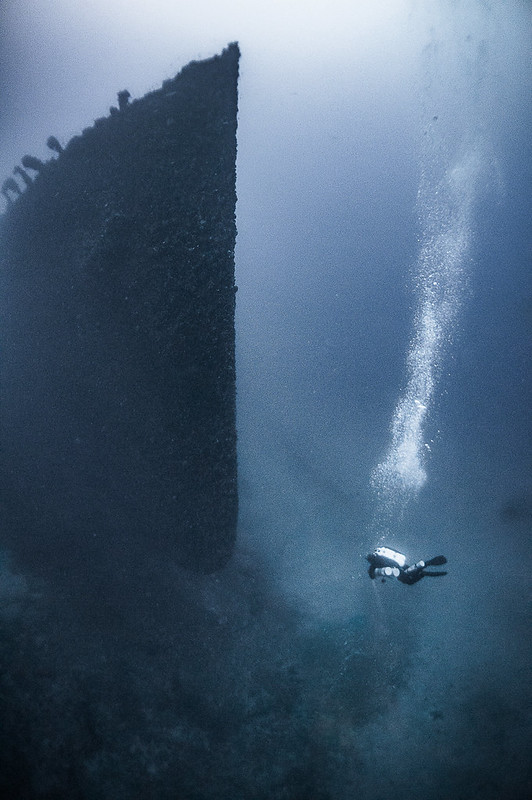
Photo: Derk Remmers
The problem begins when that same racing car is to be used on gravel.
Sidemount: misunderstood, genuinely strong
Sidemount has a reputation as a cave niche system. That’s true – and it isn’t.
What’s true: in overhead environments and technical diving, sidemount plays to its strengths. Narrow profile for restrictions, both valves and first stages directly in front of the body, every regulator in the line of sight. A valve drill becomes a visual check rather than neck acrobatics; a free-flowing regulator is immediately visible and reachable.
That’s a real advantage – but not a free pass. Sidemount has its own failure modes: “everything self-solvable” only applies to the diver who has practiced those scenarios extensively. Direct access makes problems more visible – but they’re still only resolved through practice.
A point that often gets glossed over in technical contexts: in a freeflow on one sidemount cylinder you lose a maximum of 50% of your gas – the other cylinder remains untouched. Sounds good. If the problem can be resolved by a shutdown, however, accessing the gas in that cylinder becomes difficult.
What many forget: sidemount is also a logistics tool.
A beach trolley, cylinders loaded, 500 metres to the lake – no hauling, no sweating, no back strain. After the dive: remove the rig in the water, hand the cylinders out one at a time, onto the trolley, done. Noticeably lower physical load after a demanding dive.
“The best dive ends with a wind-down, not a workout.”
And a point that often gets underestimated in the travel context: availability.
At many remote dive destinations – Mexico, the Caribbean, Southeast Asia – a manifolded double set is barely available, or only with days of advance notice. Two Alu 80s are essily found. A sidemount diver assembles their rig from carry-on luggage and has the gas they need on site. In European inland diving the calculation looks different – the steel 12 mono is often the default, and doubles are more widely available. The availability argument carries mainly while travelling, less so at the home lake.
“Two Alu 80s on location are better than a double set nobody has.”
Sidemount and the body: diving despite everything
There’s a group of divers nobody talks about much – and who owe more to sidemount than to any other system.
Experienced divers. Decades in the water. Full Cave, Tec 2 – all of it. And at some point, the body stops cooperating. A herniated disc. A hip replacement. A knee prosthesis. A back that protests for days after the walk to the lake.
These divers haven’t lost their love for diving. They just can’t carry 50 to 60 kilos on their backs to the water anymore.
Sidemount has brought several of them back into the water. This isn’t marketing – it’s practice: technically strong, precise divers who simply could no longer get their doubles to the water. With sidemount and a beach trolley, no problem – cylinders attached only in the water, no weight on the back while walking.
The limitation was never the skill. It was the logistics. And that is one of the most important and most underestimated reasons to master this system.
Where sidemount falls short – and that’s fine
Sidemount isn’t made for everything. There are clear limits:
Strong current and boat exits. Cylinders to the side, boat platform, waves, current – that gets uncomfortable, and clipping back in with moving water costs time and energy. Backmount is more stable here.
More than two stages. Two stages on a sidemount rig is manageable. Three or more gets chaotic quickly. For genuinely large amounts of additional gas, backmount plays its advantages.
Deep dives with genuine deco profiles. When the double set comes out, there’s usually a reason: gas volume and failure isolation via the manifold beat ergonomics.
Cave conservation. In sensitive cave systems, doubles – with their larger volume, wider profile, and the need to manoeuvre the manifold – play an inglorious role in disturbing sediment and making accidental contact with formations. Sidemount has a real advantage here, not only through its narrower profile but also through better body control in restrictions. For cave divers who care about the environment, this is not a marginal argument.
That’s not a defeat. That’s knowing your tools.
The quiet mistake: doubles or sidemount where a single cylinder Suffices
There’s a pattern nobody says out loud: divers showing up for a Sunday dive with doubles or sidemount – even though the dive is shallow and short, the gas volume isn’t needed, and it doesn’t serve any training purpose.
“Doubles or sidemount without a matching dive is expensive ballast.”
Here I want to put in a word for the single cylinder – it too has its place and is the right tool for certain dives. If you’re descending to ten metres, you don’t need two cylinders. If you bring them anyway because it looks more professional, you’re not making a technical decision – you’re making a social one. The uncomfortable maths: these divers come back with most of their gas. 220 bar in, 150 bar out.
The mono would have been the more honest choice. Not the smaller one – the more appropriate one.
An important distinction to avoid misunderstanding: the point is not that doubles or sidemount in a shallow lake are fundamentally wrong. I regularly dive sidemount and doubles 12 in the lake myself – either to stay longer and go deeper, or simply to keep my skills sharp. Anyone who doesn’t regularly practise what they need for the real dives is poorly advised. Handling, trim, and problem-solving only become solid through repetition.
The difference lies not in the equipment but in the intention: training is a reason to dive. “Looking more professional” is not.
The grey area – and why tt’s the most honest place
There’s a zone where both systems would work: shallow and wide caves, inland bodies of water with calm entries, dives that demand neither extreme gas nor extreme stability.
In this grey area, preference decides. And that’s completely legitimate.
In this zone I prefer sidemount – not because backmount is worse, but because it suits my way of diving: narrow profile, valves in sight, self-solvable, logistically efficient. That’s not a matter of faith. That’s self-knowledge.
What all of this means
| Situation | Right System |
|---|---|
| Difficult ocean entry, current, swell | Backmount |
| Deep tech dive, genuine deco profile, high gas volume | Backmount doubles |
| Failure isolation as priority | Backmount doubles (manifold) |
| More than two stages | Backmount |
| Cave, restrictions, valve access | Sidemount |
| Inland water, long surface carry | Sidemount |
| Travel, no doubles available | Sidemount |
| Back, knee, or hip problems | Sidemount |
| Sensitive cave systems, cave conservation | Sidemount |
| Shallow recreational dive with no training purpose | Single cylinder – and that’s fine |
Closing z hought
The question “backmount or sidemount?” is as useful as “screwdriver or hammer?” Depends on what you’re building.
Divers who master both systems, know their failure modes, and stop treating the choice as a matter of faith, dive better. Not because they have more gear, but because they know what they’re choosing and why.
Knowing your tools isn’t a luxury. It’s the difference between a dive and a good dive.
Mastering both systems isn’t something you learn by reading an article, it’s learned in the water. In sidemount the way in is TDI Intro to Tech, in backmount it is GUE Fundamentals. I teach both to the same requirements for position, trim and standardisation. Base: Deepstop Schwetzingen · thinking-diver.com