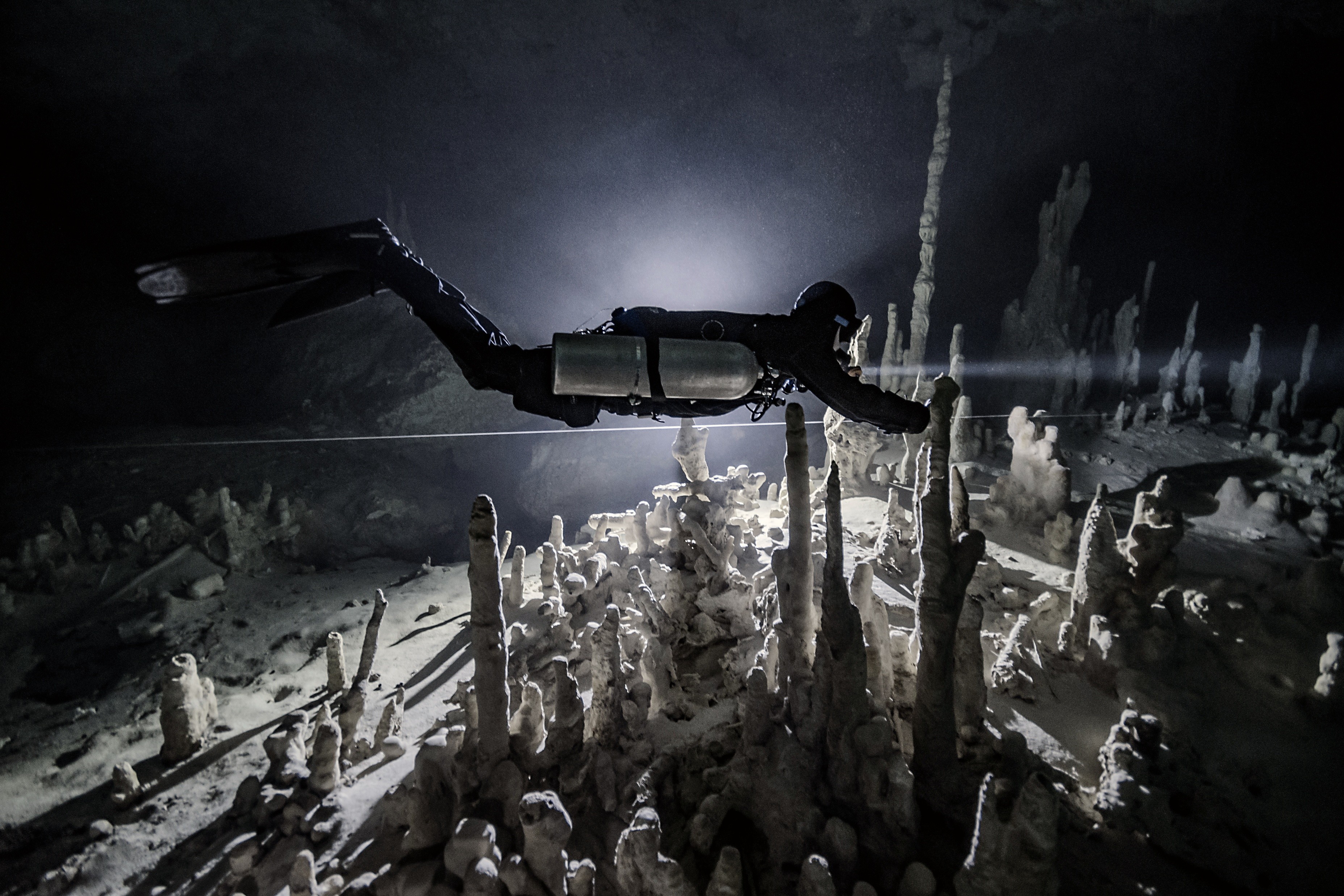
Most divers never glide. They work.
Watch the legs. Instead of one solid frog kick followed by a long, quiet glide, you get a steady patter of small kicks that never stops. Hands are always fixing something. Fins are never still. It reads as strong, athletic diving. Usually it is compensation.
The pattern is easy to spot in a class. Ask someone to hold a position, nothing else. Two seconds in, the trim slips. A kick fixes it. The kick drives them forward. The hands stop the drift. Holding still has turned back into work. Ask what just happened and most divers say nothing happened. They genuinely did not feel it. Kicking has become their resting state.
This is not a technique problem. What is missing is the calm that only arrives once the basics are genuinely yours, and the nerve to do nothing for a moment and trust where your body is in the water.
An old idea
“Slow is smooth, smooth is fast.” The phrase comes out of modern special forces training, but the thought is far older. The Romans had festina lente, make haste slowly. It was Augustus’s favourite line and he meant it as a soldier: haste and rashness were the worst faults a commander could have. Whatever is done well is done quickly enough.
The point is simple. Hurry and speed are not the same thing. Speed you can rely on comes out of awareness, never out of rushing.
One caveat, because this gets misread constantly. Slow does not mean diving slowly. Turn it into a series of tiny kicks and cover no ground all dive and you have simply found the other extreme. The kick should be strong. What matters is the rhythm, not your speed over the bottom. A powerful frog kick with a long glide covers real distance and stays completely quiet doing it.
Awareness has to be earned
Skill takes time up front. Every movement slow, thorough, finished, not because slow is a virtue but because that is the only way a skill actually becomes yours.
What nobody warns you about is that being able to do it is not the finish line. It is where the real problem starts. The moment something feels solid, you want to do it quickly, and quickly almost always turns into rushed. Your hands run ahead, your head is already two steps down the line, and you are back to doing things without being there for them.
That is the moment to stop and rebuild the awareness on purpose.
Awareness has to be earned through skill. And skill is exactly what tempts you to let it go again.
While you are still wrestling with the mechanics, there is nothing left over for anything else. Only once something is genuinely yours do you have the room to actually be present for it. That is why meditation and ceremony run on repetition: not so the movement can run itself, but so you are free enough to be there while it happens.
Every movement a kata
What holds for the kick holds for your hands. Light stowed properly. Bolt snap clipped cleanly before the hand lets go. Stage mounted clean. Line run without traps and at the right tension. A reach into the thigh pocket that finds what it went for. To a diver in a hurry these are just steps in the way: half clipped, light shoved somewhere, stage snapped onto the SPG, and every unfinished movement becomes one more thing quietly waiting for attention. That is where task loading really comes from, not from one hard job but from a stack of half done ones. One grip at a time, finished before the next begins: that is the kata. It also turns out faster, because nothing needs doing twice.
Sidemount raises the stakes. Two cylinders, two valves, two regulators, and a trim that keeps shifting as the gas goes. Plenty of what is a single action in backmount is two actions here, and each one happens at your side, right in your field of view. Cut a corner and you see it straight away: the bolt snap sitting crooked, the regulator that is not where it belongs, the cylinder that will not settle. That is a large part of why I enjoy teaching sidemount. The feedback arrives immediately.
The gas switch is the sharpest example. It has to happen briskly, nobody stands around at a switch. But brisk is not rushed. The speed comes from a clean, deliberate sequence: identify the cylinder, check the MOD, confirm with your team. It does not come from hurrying. Hurry and you drop the one check that mattered. Do it deliberately and you are fast and safe in the same movement. Festina lente, at 21 metres.
Awareness turned outward
As long as your attention is tied up with yourself, there is none left for anything else. Nowhere shows this more clearly than navigation. It asks for attention pointed outward: time, heading, depth, a running picture of the terrain while you move through it. GUE training uses circles of awareness for this. The innermost is you, then your team, then the environment around you. Navigation lives in the outer one.
You only get there when the inner circles are quiet. A diver still fighting their trim, still adjusting, still unsure of their own hands has every bit of attention spent on themselves. That diver is not navigating. They are diving and finding out afterwards where they ended up. Awareness turned outward is not something you push harder for. It is what you get once the inner work is handled and your attention is finally free.
Why I dive
If all I wanted was calm, I would meditate. Nobody needs stages and a drysuit for that.
I dive to explore too, and that does not require a plane ticket. We have a lot of water close to home, and in it plenty of ground nobody looks at because everyone runs the same route. A ledge, a stretch of bottom, a corner off the usual line. You only reach it with that outer circle working, and you only get back the same way. Calm is not the reward out there. It is the price of admission.
Then there are the dives that are about nothing at all. Weeknights after work. Those keep the movements sharp, and they are the reason the interesting dives hold together. Somewhere in them the doing turns into being. You stop diving through the water and start being in it.
Everything else, the cylinders, the wing, the newest spool, is equipment. A means to an end and nothing more. A tool can fail, it can be dropped, it can be gone. What is left is the diver: the calm, the skill, the awareness. That is what you build on. Not the kit.
If you want to build that awareness from the ground up, the systematic place to start is TDI Intro to Tech: position, trim, buoyancy, every single movement. I teach it in sidemount, held to the same standards of trim, buoyancy and standardisation I teach as a GUE instructor. Contact: christof@gue.com